The short answer
A non-DOT drug test is any workplace drug test that isn’t required by the US Department of Transportation (DOT). Most pre-employment drug tests are non-DOT, ordered by employers under their own policy for retail, warehouse, office, health care and many other jobs.
A DOT drug test is required by federal law for safety-sensitive transportation jobs, such as commercial truck and bus drivers, pilots, train crews and pipeline workers. It must follow the strict procedures in 49 CFR Part 40.
DOT vs. non-DOT drug test at a glance
| DOT drug test | Non-DOT drug test | |
|---|---|---|
| Who requires it | Federal law for safety-sensitive transportation jobs | The employer’s own policy, within state law |
| Drugs tested | Fixed 5 panel: marijuana, cocaine, amphetamines, opioids, PCP | Employer chooses: 4, 5, 10, 12 panel or custom |
| Sample type | Urine (oral fluid allowed by rule but not yet available) | Urine, oral fluid, hair or sometimes blood |
| Lab | HHS-certified laboratory | Any lab the employer’s program uses; many use the same certified labs |
| Medical Review Officer | Required | Common, but not required everywhere |
| Can marijuana be skipped? | No | Yes; some employers drop it, and some states limit it |
| Positive result | Reported to the employer; for truck and bus drivers, also to the FMCSA Clearinghouse | Reported to the employer; handled under its policy |
| Form | Federal Custody and Control Form | Non-federal custody form |
How to tell which test you’re taking
- Ask the employer or recruiter. They know whether the job is DOT-regulated.
- Look at the job. If you’ll drive a commercial vehicle that needs a CDL, or work in aviation, rail, transit, pipelines or maritime safety roles, it’s probably DOT.
- Look at the form. DOT tests use the federal custody and control form, which says so at the top.
What a non-DOT test usually screens for
Most non-DOT tests use a 5 panel or 10 panel urine test. Some employers use a 4 panel test that leaves out marijuana, and some add alcohol, fentanyl or other substances. See the 5 panel drug test and the 10 panel drug test.
Rules that still protect you in a non-DOT test
Non-DOT doesn’t mean anything goes:
- State drug testing laws. Several states regulate how employers test, confirm and act on results.
- State cannabis laws. Some states, such as California and New York, limit how most employers can use marijuana results. See does CBD show up on a drug test.
- Confirmation testing. Most programs confirm a positive screen with a more precise lab test.
- Medical review. Many programs use a Medical Review Officer who contacts you before reporting a positive result, so you can explain a prescription.
- FCRA rights. If the result reaches the employer through a background check company, you may get a pre-adverse action notice and a chance to dispute. See your FCRA rights.
Where you are in the hiring process
A drug test request usually means you have a conditional offer, at step four of the hiring process.
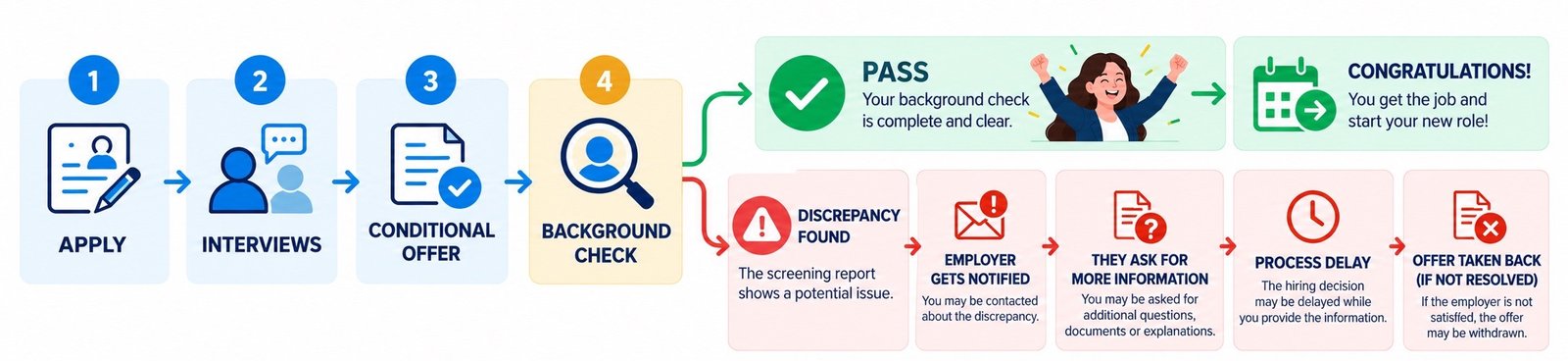
DOT or not, the drug test runs alongside a background check of your criminal records, past employers, education and sometimes your driving record. See what shows up on an employment background check.
If one of those records doesn’t match your application, the hire can take the red path in the diagram: a delay, a request for more information or a withdrawn offer. Those problems usually come from records you could have checked yourself.
You may want to see your current records at the official sources, identify any discrepancy and gather the official records that prove what is correct, before the employer’s report comes back. The Self Check Guide shows you how to do exactly that, step by step.
What’s usually in a non-DOT workplace program
A non-DOT drug test is any test an employer runs under its own drug-free workplace program rather than federal DOT rules. Many use a 5-panel or 10-panel urine screen covering drugs such as opiates and PCP. Employers decide when to test, for example pre-employment, post-accident, random or reasonable suspicion, within the limits of state law.
Safety-sensitive jobs outside DOT, such as some health care, manufacturing or security roles, often have stricter testing. The employer’s written policy should tell you what’s tested and what happens after a positive result.
Frequently asked questions
Is a non-DOT drug test easier to pass?
Not necessarily. Many non-DOT tests use the same panels and labs as DOT tests, and some test for more substances.
Does a non-DOT positive go to the Clearinghouse?
No. The FMCSA Drug and Alcohol Clearinghouse only records DOT-regulated tests for commercial drivers.
Can a non-DOT test include alcohol?
Yes, if the employer adds it. See does alcohol show up on a drug test.
How long do non-DOT results take?
Usually one to three business days for a negative result. See how long drug test results take.
What jobs require drug testing?
Federal rules require drug testing for safety-sensitive transportation jobs, such as truck drivers, pilots and some rail and transit workers. Many other employers test by choice, especially in healthcare, construction, manufacturing, warehousing and jobs with driving or machinery.
What does a non-DOT drug test test for?
Whatever the employer chooses. A non-DOT or non-regulated drug screen is often a 5-panel or 10-panel urine test, but panels can be customized. Ask which substances are included.
Your next step
Ask whether your test is DOT or non-DOT and which panel it uses, keep your prescription details ready, and check the other records your employer is reviewing.