The short answer
A DOT drug test is a federally regulated urine drug test for safety-sensitive transportation workers. For commercial truck and bus drivers with a CDL, the rules come from the Federal Motor Carrier Safety Administration in 49 CFR Part 382, and the testing procedures come from 49 CFR Part 40.
The test uses the standard 5 panel: marijuana, cocaine, amphetamines, opioids (including hydrocodone, hydromorphone, oxycodone and oxymorphone) and PCP. Results go through an HHS-certified lab and a Medical Review Officer (MRO).
The types of DOT drug and alcohol tests
| Test | When it happens | Key rule |
|---|---|---|
| Pre-employment | Before you first drive for an employer | A negative drug result is required before you can drive. Alcohol testing is optional |
| Random | Unannounced, throughout the year | You must go to the collection site right after you’re notified |
| Post-accident | After certain crashes | Alcohol test within 8 hours; drug test within 32 hours |
| Reasonable suspicion | When a trained supervisor observes signs of use | Based on specific, documented observations |
| Return-to-duty | Before going back to safety-sensitive work after a violation | Directly observed; requires a Substance Abuse Professional’s evaluation |
| Follow-up | Unannounced tests after returning to duty | At least 6 in the first 12 months; can continue up to 5 years |
The post-accident time limits are in 49 CFR 382.303. Not every crash requires a test. It depends on whether there was a fatality, injuries treated away from the scene, or a vehicle towed away, combined with a citation.
How DOT random drug testing works
- Your employer, or the consortium it belongs to, randomly selects drivers from a pool each year.
- FMCSA sets the minimum annual random testing rates each year, separately for drugs and alcohol.
- Every driver in the pool has an equal chance of selection each time, so you can be picked more than once.
- When you’re notified, you must stop what you’re doing and go to the collection site immediately. Delaying without a valid reason can count as a refusal.
The FMCSA Drug and Alcohol Clearinghouse
The Clearinghouse is an online database of CDL drivers’ DOT drug and alcohol program violations, such as positive tests and refusals. Employers must query it before hiring a CDL driver and at least once a year after that. A violation stays in the Clearinghouse for five years, or until you complete the return-to-duty process, whichever is later. You can register and view your own record.
What’s new in DOT drug testing
DOT updates its rules from time to time. Recent changes include approving oral fluid (mouth swab) testing as an alternative to urine, though it can’t be used until enough labs are certified. See mouth swab drug tests. Check the DOT Office of Drug and Alcohol Policy and Compliance for the latest rules.
What happens after a DOT positive or refusal
You must be removed from safety-sensitive duties right away. To drive again for any DOT employer, you must complete the return-to-duty process with a Substance Abuse Professional (SAP), pass a directly observed return-to-duty test and complete follow-up testing. See what happens if you fail a pre-employment drug test.
Where you are in the hiring process
For a new driving job, the DOT drug test, the DOT physical and your background check usually happen together after a conditional offer.
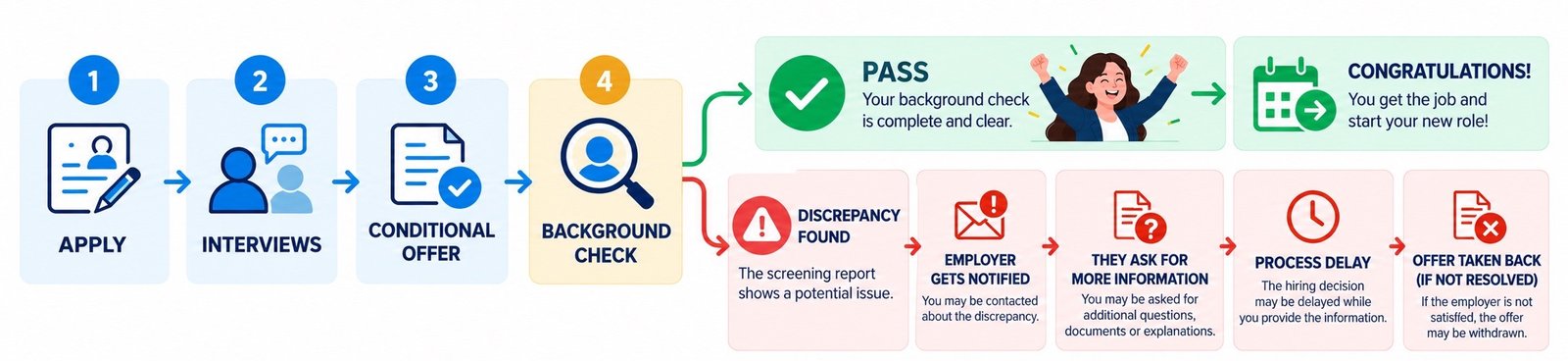
Driving employers also check your driving record, past driving employers and Clearinghouse record. See the DOT background check for truck drivers. If any record is wrong, such as a ticket that isn’t yours or a past carrier with the wrong dates, the hire can be delayed or the offer withdrawn.
You may want to see your current records at the official sources, identify any discrepancy and gather the official records that prove what is correct, before the employer’s report comes back. The Self Check Guide shows you how to do exactly that, step by step.
DOT drug testing requirements at a glance
DOT drug testing requirements are set out in federal regulations at 49 CFR Part 40, which spells out the chain of custody, the lab process and the medical review. The specific substances tested are marijuana, cocaine, amphetamines, opioids and phencyclidine (PCP). Anyone who performs a safety-sensitive function, such as driving a commercial motor vehicle, must pass a pre-employment drug test before starting.
DOT compliance also includes random tests, post-accident tests and return-to-duty and follow-up testing after a violation. A DOT drug screening is different from a company’s own non-DOT test, which isn’t covered by these DOT regulations.
Frequently asked questions
Does a DOT drug test include alcohol?
The drug test doesn’t. Alcohol testing is a separate breath test used for random, post-accident, reasonable-suspicion and other tests. Pre-employment alcohol tests are optional. See does alcohol show up on a drug test.
Can I use CBD as a CDL driver?
DOT says CBD use is not a valid explanation for a marijuana-positive result. See does CBD show up on a drug test.
How long do DOT drug test results take?
Negative results often come back in one to three business days. See how long drug test results take.
Is a DOT drug test different from a non-DOT drug test?
Yes. See non-DOT vs. DOT drug tests.
When is a DOT post-accident drug test required?
After certain accidents involving a commercial vehicle, such as ones with a fatality, or with injuries or vehicles towed away when the driver gets a citation. The rules set time limits for alcohol and drug testing after the accident.
Your next step
Register to view your own Clearinghouse record, keep your prescription details ready for the Medical Review Officer, and check your driving record before your new carrier does.